Student Proofreading Service: Fix the Small Errors Before You Submit
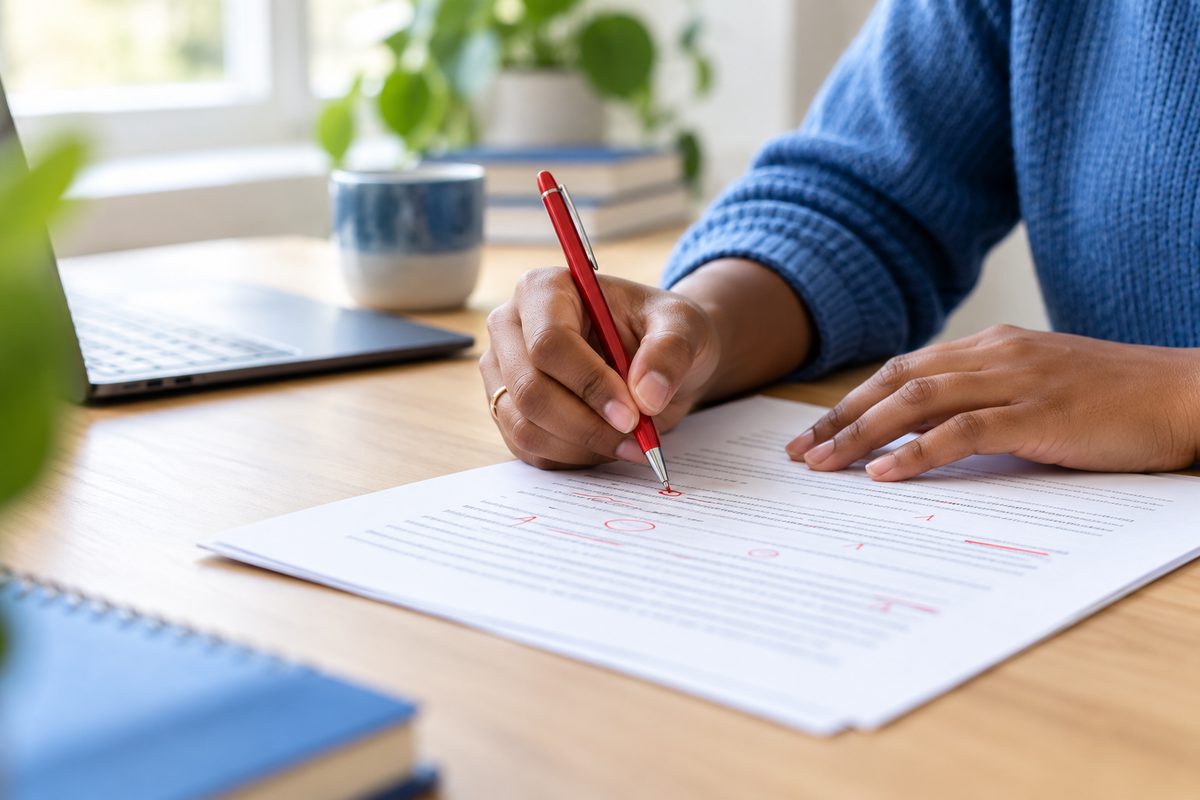
Our student proofreading service is a careful last check of your own draft. We mark spelling, grammar, formatting and referencing slips in comments, and you make every change yourself. Your ideas and your words stay yours, and you hand in your own work.
Pricing
Enter your word count and deadline to see a price before you commit.
Student proofreading service: what you get
You receive a marked draft and a short list of repeat problems. We flag errors and explain them. We do not rewrite your argument.
Comments beside each error
Each comment names the slip, such as a missing word or a wrong tense, and shows the fix. You accept or reject every suggestion in your own file, so the final text stays your own.
A list of your repeat mistakes
If you mix up two words ten times, you see it once, with the pattern explained. This helps you spot the same habit in your next piece of work.
Notes on consistency
We check that headings, spellings, numbers and fonts follow one style from the first page to the last.
A short summary of what to check next
You get a plain list of anything we could not judge, such as a fact or a calculation, so you can check it yourself.
How it works
Four steps, with you in charge of the final text. The how it works page has the full detail.
- Send your finished draft, word limit and deadline.
- Receive a quote that says what is included.
- Get your marked draft and summary.
- Accept or reject each change, then submit your own work.
What is included
- Spelling and typing errors marked
- Grammar and punctuation comments
- Repeated and missing words flagged
- A referencing format check
- Consistency notes on headings and layout
- A list of your repeat mistakes
A proofreading checklist you can use today
Work through these six checks before you send anything to anyone.
- Have you left a gap between finishing and proofreading, ideally a night?
- Have you read the draft aloud, or used your computer's read-aloud tool?
- Does every point in the brief and marking criteria have an answer?
- Do the word count and formatting match your module guide?
- Does every in-text citation appear in the reference list, and the reverse?
- Have you read the draft once for each type of error, not all at once?
Our study guides cover planning and structure, which come before proofreading.
Referencing check
A reference list can be right in content and wrong in format. We compare your citations with the style guide you name, such as Harvard or APA, and point out gaps. Check university advice too: Sunderland's library suggests Cite Them Right Online for this job.
What we look at
Author names, dates, titles, page numbers and punctuation. We also check that each in-text citation has a matching entry in the list.
What we do not do
We do not find new sources or decide which evidence you should use. For that, see our literature review support.
Grammar check
Software catches many slips but misses some, such as a correct word in the wrong place. A human reader catches those. Read our notes, then decide whether each change suits your voice.
Spelling, tense and punctuation
Typical marks include the wrong tense, a stray comma, a mixed-up pair like "affect" and "effect", and a sentence with no verb.
Clarity without rewriting
If a sentence is too long to follow, we flag it and say why. You rewrite it in your own words. This keeps your ideas and your voice unchanged.
Worked example: a 3,000-word essay
Invented example. A student sends a finished essay two days before the deadline.
| Issue found | Count | Who fixes it |
|---|---|---|
| Missing or repeated words | 9 | The student |
| Tense changes within paragraphs | 6 | The student |
| Citations missing from the reference list | 4 | The student |
| Inconsistent heading styles | 3 | The student |
| A figure that looks wrong | 1 | Flagged; the student checks the source |
Every change is accepted or rejected by the student, never by us.
Final read
Before you submit, read the whole piece once more, slowly, from a printed copy if you can. Annotate on paper, then update the file. This is also the time to read the brief again and confirm every point has an answer.
What to do if you are short of time
Fix the errors that change meaning first, then references, then layout. Leave style preferences until last. See our assignment support page for planning backwards from a deadline.
Declaring help
Some universities ask you to declare any proofreader you used. Check your regulations before you submit.
Before you send your draft
- The finished draft in Word format
- The brief and word limit
- Your referencing style guide
- Your deadline, including the time of day
- Any rules your department gives on proofreading
Who this is for
- Undergraduates and postgraduates at UK universities
- Students who write in English as an additional language
- Students with dyslexia who want a second reader
- Part-time learners finishing work late in the evening
- Anyone with a finished draft and a deadline
All our work is for guidance and reference. You must write and submit your own work, in line with your university's or awarding body's academic integrity rules.
Related help
Sources
- University of Sunderland Library, Hints and tips for proofreading
- University of Hull Library, Proofreading guidance
- University of Leicester, Proof-reading policy
Frequently asked questions
How much does a student proofreading service cost?
The price depends on word count and deadline. Use the calculator above for a price before you commit.
How long does it take?
It depends on length and your deadline. Tell us the deadline when you ask for a quote, and we confirm what is possible. We can get started as soon as you share your assignment brief and deadline. Our team will review your requirements and confirm the earliest possible start time and a realistic turnaround based on the complexity and scope of your work.
What do I receive?
You receive your draft with comments, a list of repeat mistakes and a short note of anything to check yourself.
Will proofreading raise my grade?
We cannot promise a mark. Fewer errors make your work easier to read, but marks depend on your content and your marker.
Is my work kept private?
We use your draft only to give you comments.
Is proofreading allowed at my university?
Rules differ. Some universities allow limited proofreading and ask you to declare it. Read your own regulations first.
Will you change my ideas or argument?
No. We mark errors and explain them. Your ideas, structure and conclusions stay as you wrote them.
Do you write or rewrite my work?
No. We comment and you make the changes. You write and submit your own work.
Can you check my calculations or data?
No. We flag a figure that looks odd, but you check the source and the working yourself.
Which subjects do you cover?
Tell us your subject and level when you ask for a quote. We cover these subjects: Accounting, Academic Writing, Business, Computer Science, Economics, Education, English Literature, Finance, Geography, Health and Social Care, History, HR, IT, Law, Management, Marketing, Media and Communication, Nursing, Programming, Psychology and Sociology.